WHAT IS ARCHES?

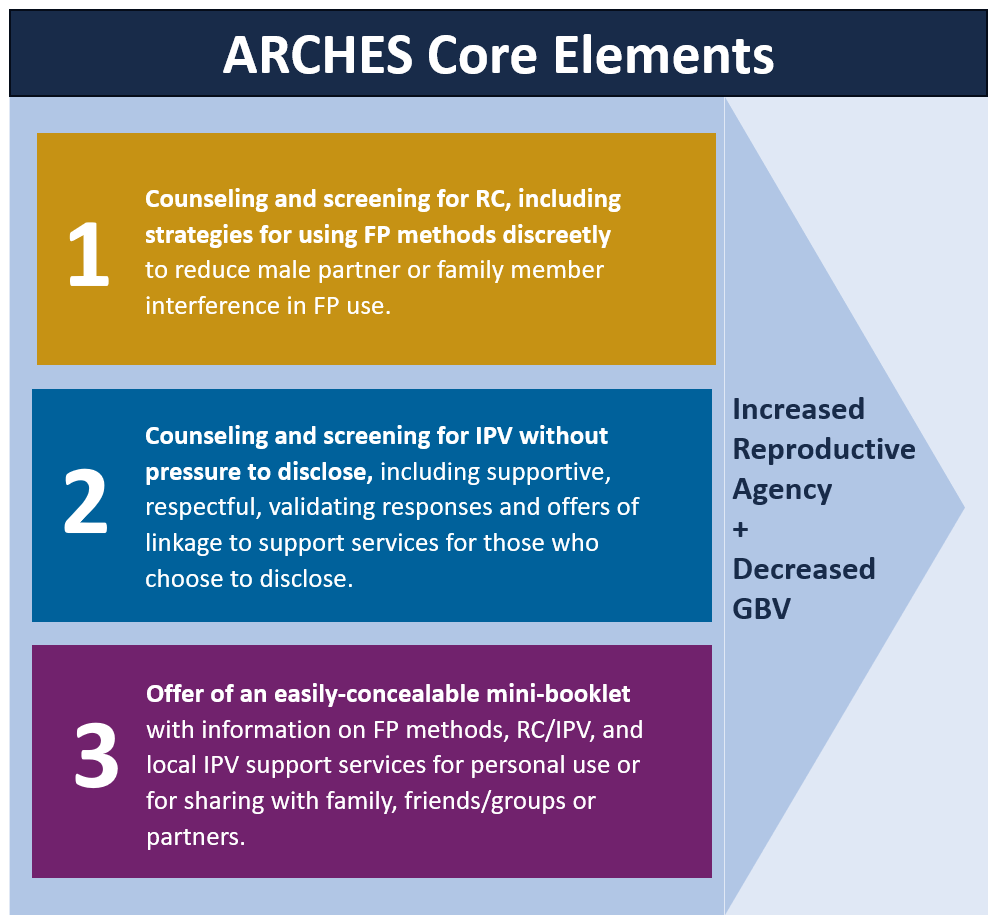
ARCHES (Addressing Reproductive Coercion in Health Settings) consists of three core elements that are readily integrated into existing family planning counseling models and is demonstrated to support women’s reproductive agency, reduce gender-based violence (GBV) and improve quality of care. ARCHES elements are incorporated into a single counseling session and take minimal time to deliver (less than two minutes in the most recent study). ​

Universal, rights-based, woman-centered care​

ARCHES prioritizes the unique needs, preferences, and experiences of women and supports their rights to:​

  • Universal Counseling: The receipt of comprehensive, accurate, unbiased education and support including information to assist them to cope with reproductive coercion (RC) and intimate partner violence (IPV), regardless of disclosure.
  • Reproductive Autonomy: Emphasis on women’s right to control family planning decisions independently, including the decision to use family planning without partner or family knowledge. ​
  • High Quality, Woman-centered Care: The receipt of high-quality, respectful, confidential, person-centered reproductive health care, free from bias or coercion.​

Why address reproductive coercion?

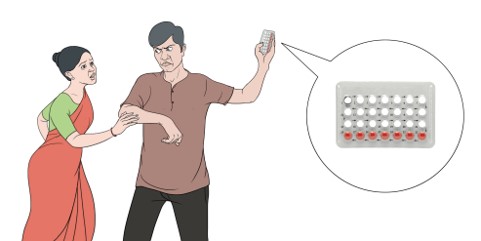
RC describes behaviors by a male partner or family member(s) designed to interfere with women’s and girls’ family planning use or pregnancy decisions. RC is a distinct form of gender-based violence (GBV) that often co-occurs with IPV. In population-based surveys from sub-Saharan Africa and South Asia, 3-20% of women report experiencing reproductive coercion in the past year. Studies among women seeking health services consistently find high prevalence rates (e.g., 42% in our most recent study).

Pregnancy Coercion: Forcing or pressuring a woman or girl to become pregnant and/or discontinue contraceptive use against her will; OR to use contraceptives or be sterilized to prevent pregnancy against her will.​

Contraceptive Sabotage: Deliberately hiding, withholding, destroying, or removing family planning methods against a woman’s will or preventing her from seeking care for family planning or otherwise blocking access to family planning.​

Abortion Coercion: Forcing or pressuring a woman to terminate or continue a pregnancy against her will, or impeding access to safe abortion services.​

RC is associated with poor health outcomes:​

  • Women reporting reproductive coercion are 4.7 times more likely to report experiencing unintended pregnancy​​.
  • Women reporting reproductive coercion are 8.0 times more likely to report experiencing IPV.

How has ARCHES evolved?

ARCHES was first developed and tested in the United States. Based on positive findings in two cluster randomized controlled trials with >4,000 women, ARCHES was adapted to low- and middle-income country settings starting with Nairobi, Kenya in 2015. Since then, ARCHES has been adapted and evaluated in multiple country settings and service contexts. See the timeline below for major milestones of the intervention expansion and evaluation. Learn more about the ARCHES adaptations in the map below and on the project pages.

United States: Original development and evaluation of approach in private family planning clinics in California and Pennsylvania.

Kenya: Adapted and evaluated for family planning counseling in IPPF private clinics and public clinics with the Ministry of Health. Adaptation and evaluation underway for women’s economic empowerment groups. More

Bangladesh: Adapted and evaluated for abortion services in urban facilities and for humanitarian setting in Cox’s Bazar. More

Mexico: Adapted for family planning counseling in IPPF private clinics. More

Nigeria: Adapted and evaluated for antenatal care (ANC) and family planning counseling in public facilities. More

India: Adaptation and evaluation underway for family planning counseling in private FPAI and public facilities and community-health workers. More

Bolivia: Adaptation underway for abortion and family planning counseling in public sector facilities. More

DRC: Adaptation for inclusion in “Nurse Nisa” digital, client-facing WhatsApp-based chatbot. More

Indonesia: Adaptation underway for family planning counseling in public sector facilities. More

What are next steps for ARCHES?

ARCHES is currently being expanded to exciting new areas of work to increase the reach of the intervention and improve implementation and sustainment for scale-up.

Digital innovations

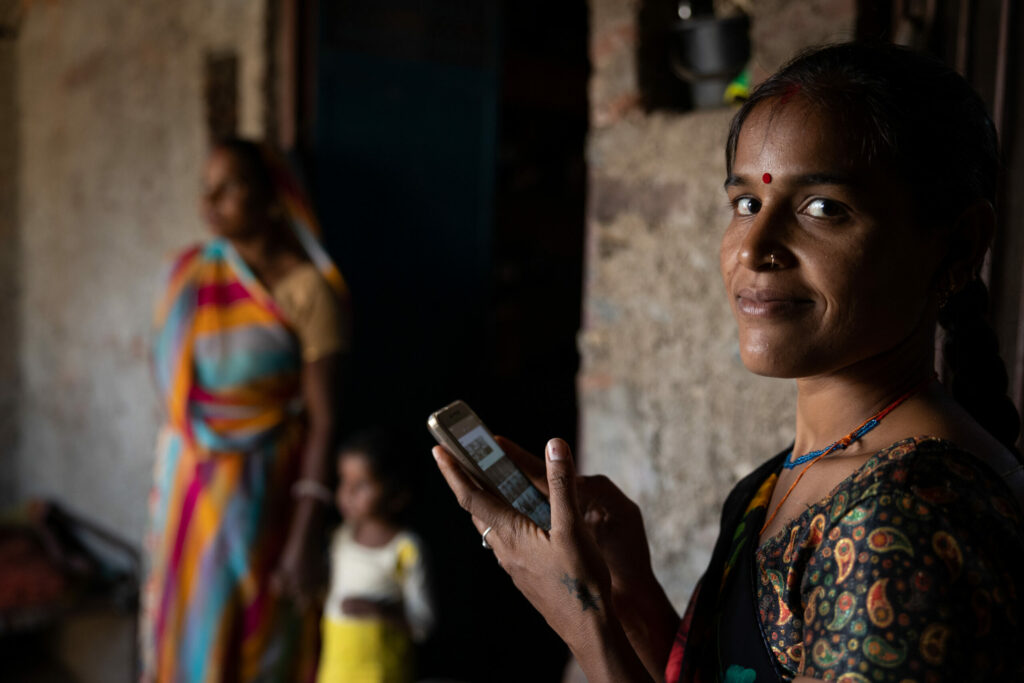
In the Democratic Republic of Congo (DRC), ARCHES messages were integrated into the Nurse Nisa WhatsApp-based chatbot to allow women to access relevant information from anywhere.

Extensions to Humanitarian Settings

In Cox’s Bazar, Bangladesh, ARCHES has been adapted for use with Forcibly Displaced Myanmar Nationals seeking menstrual regulation (a form of abortion care), postabortion care, or family planning services in health facilities located in refugee camps. 

Extensions to Community Health Workers

In Gwalior, India and Dhaka, Bangladesh, where use of community health workers is highly utilized across the family planning system, ARCHES is being adapted for training and implementation by community health workers to reach women who may have difficulty traveling to health facilities for service. 

Extensions to Women’s Economic Empowerment Groups

In Uasin Gishu, Kenya, ARCHES elements are being delivered within community-based women’s economic empowerment groups to build social and financial support for women experiencing gender-based violence.​

Design for scale

In Uasin Gishu, Kenya ARCHES was adapted for implementation with Ministry of Health clinics using the ExpandNet Beginning with the End in Mind framework to design a scalable and sustainable model.  

Digital innovations 

In Uasin Gishu, Kenya a provider-facing app to facilitate delivery of ARCHES as integrated within family planning counseling was developed and shown to significantly improve rates of implementation.

The ARCHES team is currently exploring opportunities to further ARCHES research and learning in the following areas: 

  1. Further expansion and scaling of ARCHES in additional low- and middle-income country (LMIC) contexts
  2. Further development of digital innovations to facilitate implementation and sustainability
  3. Further development and testing of ARCHES outside of the health system